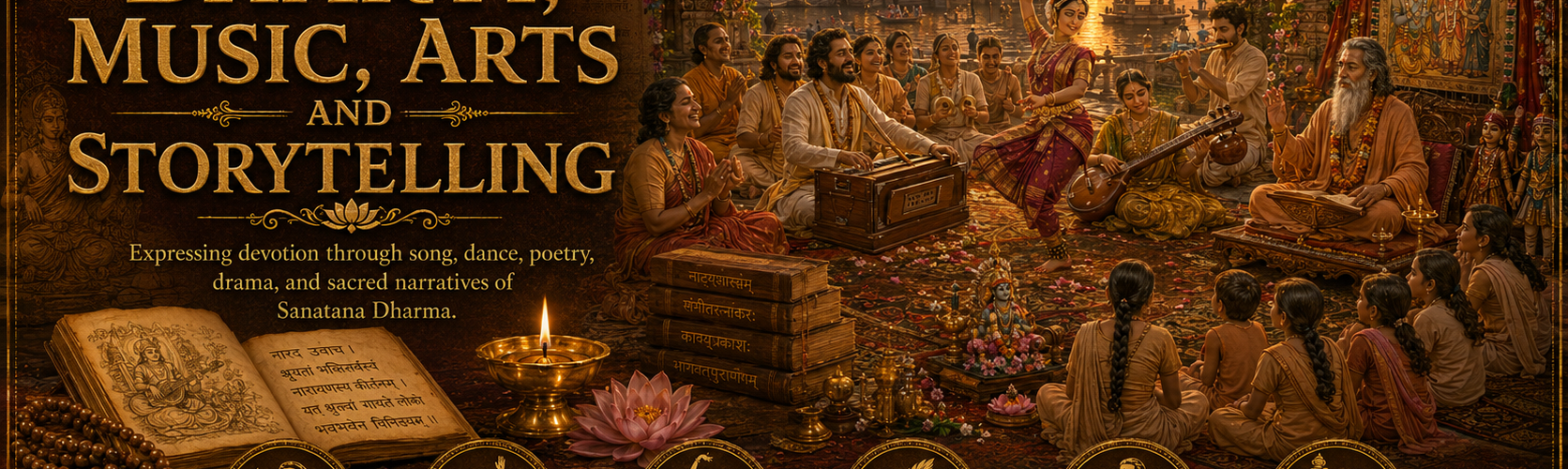
Start with the essentials
Five quick cards provide a beginner-friendly orientation before you explore the deeper framework.
How Bhakti, Music, Arts and Storytelling support modern learning
A quick visual snapshot for Gen Z learners showing how devotion, music, dance, theatre, story, visual art and digital creativity connect through emotion, memory, beauty and community.
🎶 Devotional expression
Helps users understand how bhakti becomes accessible through kīrtan, bhajan, poetry, mantra, melody and shared participation.
🎭 Embodied storytelling
Connects dance, theatre, katha, visual arts and regional performance with sacred stories, values and cultural memory.
🌐 Responsible adaptation
Shows how modern media can share tradition with global audiences while respecting source, context, artists and communities.
What you will understand
Use these outcomes to track what the page is designed to teach.
See how the ideas connect
Bhakti, music, arts and storytelling are interconnected through devotion, emotion, memory, creativity and community.
Understand the reasoning structure
This standard framework can be reused across all 20 concept pages.
Explore bhakti, music, arts and storytelling
Open each topic to study definition, context, logic, values, sources, application and reflection.
How devotional and artistic traditions developed
This is an introductory timeline; dating, authorship and emphasis may be debated.
Compare major perspectives
Responsible learning distinguishes shared introductory language from school-specific positions.
From traditional dialogue to modern life
Examples help users move from abstract ideas to real ethical analysis.
How this can help today
Applications are reflective educational lenses, not guaranteed outcomes or professional advice.
Myth versus context
Clarifying misconceptions improves trust and prevents oversimplification.
Turn learning into inquiry
Use one reflection and one small practice rather than trying to apply everything at once.
Test your understanding
A short quiz provides immediate feedback and reinforces the key distinctions.
Continue responsibly
Use primary texts, recognised commentaries, qualified teachers and careful scholarship.